
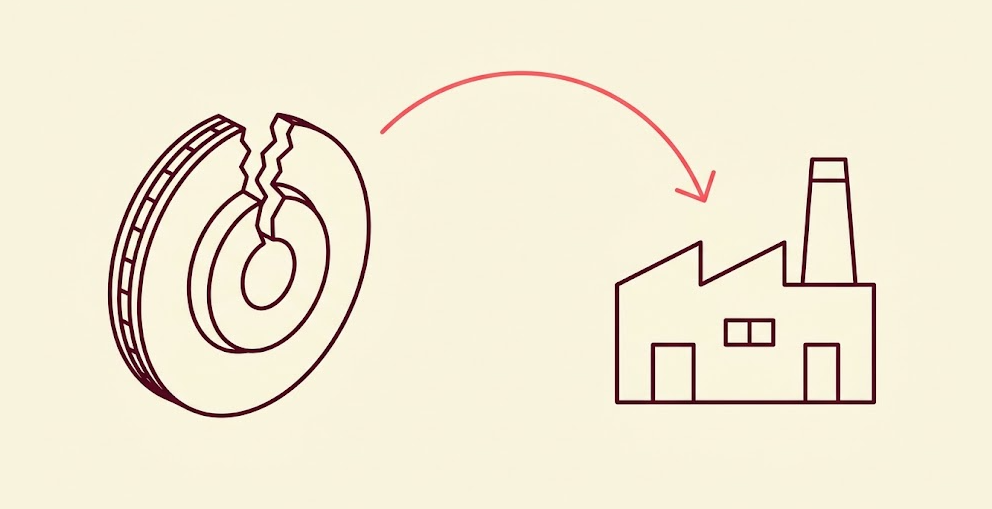
A counterfeit part is built to carry someone else's name. That is the entire point of it: the margin comes from the name, not from the metal.
Which means that when the part fails, it fails under that name.
How does the bill reach the manufacturer?
Through the ordinary warranty process, working exactly as designed.
The car owner has a part that broke. The part says it was made by a particular manufacturer. They take the vehicle to a dealer, the dealer opens a claim against that manufacturer, and the manufacturer receives a request to pay for a repair on something they never built.
Nobody in that chain is acting in bad faith. The owner bought what they were told was genuine. The workshop fitted what they were sold. The dealer processed a claim the way they process every other one.
Why can't the claim simply be refused?
Because refusing means proving a negative, and the counterfeit was built to make that proof impossible.
The housing matches. The markings match. The part number matches. The box matches. A manufacturer looking at the returned part is looking for something that distinguishes it from their own production, and a good copy has removed those differences on purpose.
What is left is an argument between two assertions: the customer says it is genuine, the manufacturer says it is not. Honouring the claim costs a repair. Refusing it costs a customer, a dispute, and sometimes a public one. Many claims get honoured for that reason alone.
What does this cost at scale?
Warranty already runs between 2.5 and 3.5 percent of revenue for automotive manufacturers, and that is the cost of standing behind their own parts.
Counterfeit goods account for USD 467 billion of world trade. In car parts in the European Union, EUR 4.3 billion a year. The concentration matters as much as the total: bulbs, bearings and shock absorbers are among the most copied items, and all three are components where a failure is a safety event.
What happens when the defect is real?
The second cost has nothing to do with counterfeits, and it comes from the same missing record.
When a genuine part turns out to have a defect, the manufacturer has to decide which vehicles received it. Without identity at the unit level, that question cannot be answered precisely, so the recall is widened until it is certainly large enough. Cars that were never at risk come back anyway.
GM recalled every Chevrolet Bolt built since 2016 — more than 140,000 vehicles worldwide — after thirteen reported battery fires. The defect was in battery modules from one supplier, and LG agreed to reimburse between 1.9 and 2 billion dollars of the cost. The scope was set by what could not be isolated: the recall covered every car built in a five-year span because there was no way to name the ones carrying the affected modules.
What changes with a record per part?
Two things, and neither of them recovers money already spent.
A claim becomes checkable. A part that can prove itself turns a dispute into a fact, which is what lets a manufacturer decline a claim on something they never made without calling their customer a liar.
And a recall becomes narrow. If each unit is recorded, the affected ones can be named and the rest stay on the road.
Neither is dramatic. Both are the difference between a cost that can be managed and one that cannot.